Why Solar Comes Up So Often for Rural Barndominium Builds
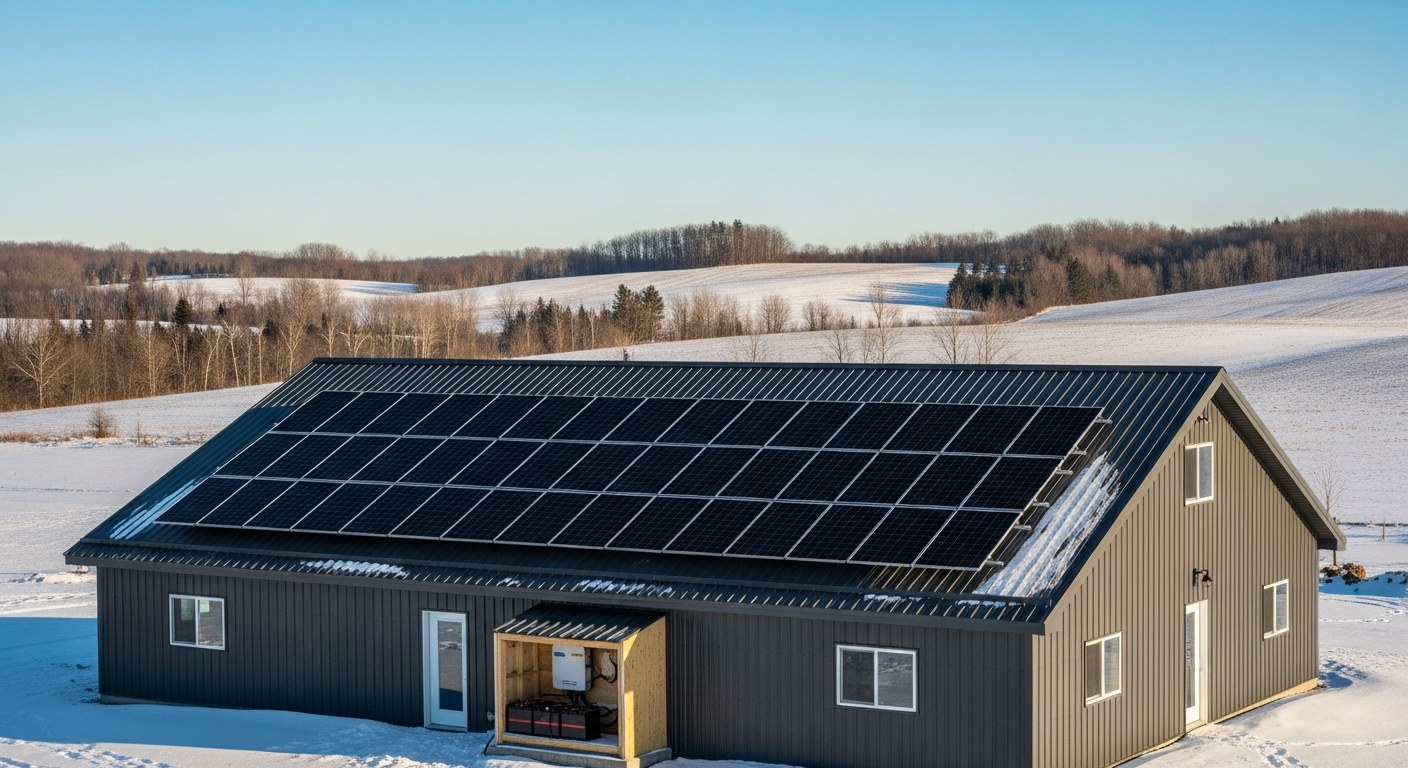
Two things push rural and acreage builders toward solar that don't apply to a typical subdivision home. First, a large post-frame roof is genuinely good solar real estate — more usable south-facing area than most house roofs offer. Second, distance from the grid is a real cost variable: running a new power line to a remote parcel can cost tens of thousands of dollars in pole and trenching fees, to the point where a solar-plus-battery system is sometimes the cheaper option, not the greener-but-pricier one.
That second point is worth confirming with your utility before you assume either direction — get an actual line-extension quote before deciding solar is "instead of" the grid rather than "in addition to" it.
Grid-Tied, Off-Grid, or Hybrid — Pick the Right Category First
Grid-tied systems stay connected to the utility grid and typically use net metering — your panels offset your bill, and excess production credits back to you (terms vary meaningfully by province and utility, more on that below). No batteries required, lowest cost, but you lose power when the grid does, same as anyone else.
Off-grid systems have no utility connection at all — batteries store what the panels produce, and the system has to be sized to cover your worst-case winter production against your actual load, not your average. This is the right call for genuinely remote parcels where a grid connection isn't realistic, and the wrong call for a site where cheap grid power is available and you just want backup resilience.
Hybrid systems stay grid-tied but add battery backup, so you keep net-metering economics and gain outage protection. For most Canadian rural barndominium builds within reasonable grid distance, this is the practical middle ground — you're not paying for a fully off-grid battery bank sized for worst-case winter, but you're not powerless during an outage either.
Sizing for a Barndominium Specifically
A barndominium's electrical load profile is genuinely different from a standard house, and that changes solar sizing math. Shop tools, welding equipment, air compressors, and EV charging all add real peak-demand load that a residential-only solar calculator won't account for. If your electrical panel sizing already accounts for shop loads and EV charging headroom, your solar sizing needs to be run against that real peak, not against a typical home's average draw — undersizing here means the system looks fine on paper and falls short the day you're welding and charging a vehicle at the same time.
Battery Backup vs. Generator Backup
These aren't competing choices — most well-planned rural systems use both, for different jobs. A battery bank backed by solar handles day-to-day outage resilience quietly and automatically. A generator with a proper manual transfer switch covers the extended-outage scenario a battery bank alone can't — several days of low-sun winter weather with no grid power is exactly when a generator earns its cost, and it's a much cheaper way to cover that edge case than oversizing a battery bank to handle it.
Net Metering Varies by Province — Confirm With Your Utility
Net metering terms — how credits are calculated, whether they roll over, whether there's an annual settlement — are set provincially and sometimes utility-by-utility within a province. This isn't something to assume from a general answer online; it's a real economic input to your payback calculation, and it's worth a direct call to your utility before finalizing system size.
The Counterintuitive Cold-Climate Fact
Solar panels are actually more efficient in cold temperatures — panel output drops as cell temperature rises, so a cold, sunny Canadian winter day can outperform a hot summer day per panel, watt for watt. The real production loss in winter comes from shorter daylight hours and snow cover on the panels, not the cold itself. And a steep metal roof pitch that sheds snow well (see our metal roofing guide) has a real secondary benefit here: panels clear of snow faster than they would on a shallow-pitch or flat-mounted array, meaning less lost production after a snowfall.
Realistic Cost Ranges (Canada, 2026)
- Grid-tied, no battery: $2.50–$3.50 per watt
- Hybrid (grid-tied + battery backup): $3.50–$5.50 per watt
- Fully off-grid: $5.00–$8.00+ per watt
A typical barndominium-scale system (8-12 kW) lands roughly $25,000-$65,000 depending on category — a wide range because battery capacity, not panel count, is usually what drives the total.
Where This Fits in Your Planning
Solar and backup power decisions touch your electrical panel design, your roof structure, and your mechanical room layout — all things that need to be settled before rough-in, not added on after the fact as a retrofit. If you're planning a rural build, work solar into your pre-pour checklist review rather than treating it as a separate project once the house is finished, and use the cost estimator to see how it fits your overall budget by region.